

Fiber Optic Cable Guide: Single-Mode vs Multi-Mode Fiber
Fiber Optic
In the past, network cables with metal conductors had a common problem: the signal inside the cable could be disrupted by electromagnetic interference from many sources, such as electrical appliances that create magnetic fields, or even natural events. For example, the internet drops out when it rains. This problem affected a lot of users. The cable that replaced metal-conductor cabling is fiber optic cable (optical fiber cable).
Fiber optic is a type of data cable that can run for many kilometers and supports high speeds (high bandwidth) with very low signal loss. It is also smaller and lighter than other types of cable. That is why fiber optic cable is now widely used in large cabling projects and in systems that need high stability ➜ (Loss calculation)
Basic Structure of a Fiber Optic Cable

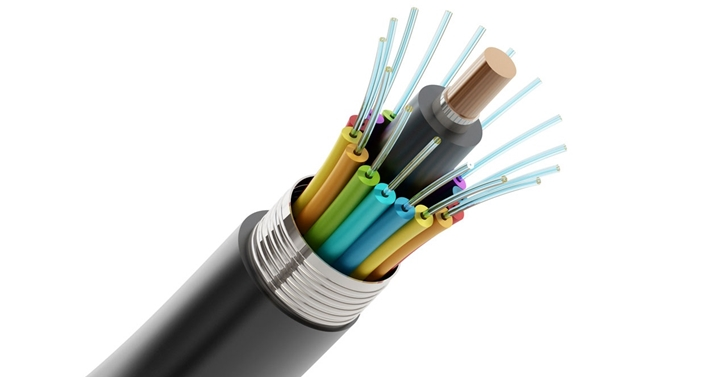
- Cable Jacket/Sheath: The outermost layer. It protects all the parts inside the optical fiber cable.
- Strengthening Fibres: Fibers that add extra protection.
- Coating/Buffer: The outer layer that wraps around the cladding. The “coating” is made of one or more layers of polymer that protect the silica (glass) structure from physical and environmental damage.
- Cladding: The layer next to the core. It refracts the light and acts as the core's outer shell.
- Core: The innermost layer, through which the light travels.
How Many Types of Fiber Optic Cable Are There?
There are two types: Single-Mode and Multi-Mode. Single-Mode means the cable lets light travel along only one path. Multi-Mode means the fiber lets light travel along several paths.
Wavelengths and Light Sources
Because Multi-Mode fiber is larger, light sources such as LEDs (light-emitting diodes) and VCSELs (vertical-cavity surface-emitting lasers) operating at wavelengths of 850 nm and 1300 nm are used in Multi-Mode fiber optic cable. Single-Mode fiber, on the other hand, usually uses a laser or laser diode to produce the light sent into the cable, and the most common Single-Mode fiber wavelengths are 1310 nm and 1550 nm.

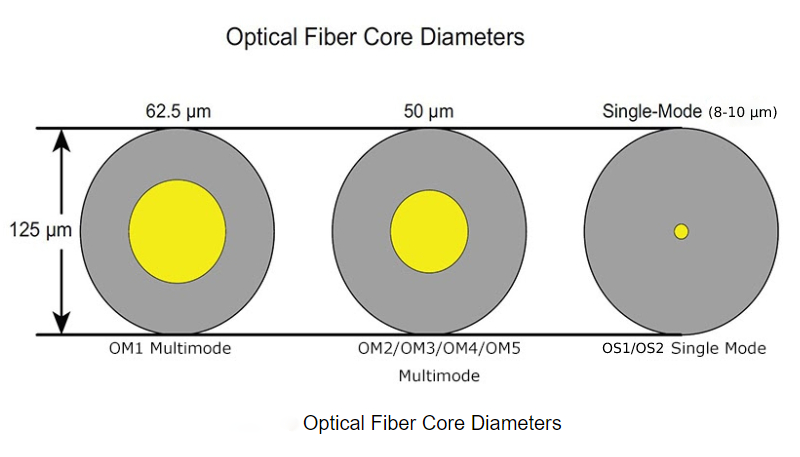
Single-Mode Fiber (SMF) has a core diameter of 8–10 μm and a cladding diameter of 125 μm. It can transmit at up to 2,500 Mbps over distances of up to 20 km. In real-world use it can carry data up to 100 km at no less than 1,000 Mbps. Whether your internet speed is 10 Mbps, 100 Mbps or 1,000 Mbps (1 Gbps), Single-Mode fiber can carry the signal without limits and without any drop in speed.
Light propagation type: Step Index (Single-Mode) – the core and cladding have different refractive indices. Single-Mode fiber has a very small core ( 10 GHz·km), so there is no pulse broadening and no transit time differences.

There are two types of Single-Mode fiber: OS1 and OS2. They differ in attenuation (signal loss), as defined in the ISO/IEC and EN standards

OS1 and OS2 are Single-Mode fiber cables that use 1310 nm and 1550 nm wavelengths, with maximum attenuation of 1 dB/km and 0.5 dB/km.
Differences Between OS1 and OS2

Choosing Between OS1 and OS2
Comparing the two, OS2 is the better choice for long-distance transmission, as it performs better with less loss. In fact, OS1 was once the only standard for Single-Mode fiber, with a maximum campus cabling length of about 10 km. That no longer meets today's growing need for longer cable runs.
OS2 is well suited to 1G/10G/40G/100G Ethernet and meets high-performance needs over long distances of up to 200 km. For this reason, more and more vendors now offer solutions using OS2 SMF cable for modern network applications.
Multi-Mode Fiber (MMF) has a core diameter of 62.5 μm or 50 μm and a cladding diameter of 125 μm. Because of its small core, it transmits over shorter distances and has lower bandwidth than Single-Mode fiber, with a maximum speed of 100 Mbps over distances of up to 200 meters. However, Multi-Mode fiber is easier to manufacture than Single-Mode fiber.

- Step Index Fiber Optic (Multi-Mode) The size in common use is 9/125 µm fiber at a 1300 nm wavelength for long distances.

Graded Index Fiber Optic (Multi-Mode) In graded-index fiber, the refractive index changes gradually from the core to the cladding. As a result, transit time differences and pulse broadening are small, giving low attenuation. Bandwidth is < 1 GHz·km. Common sizes are 50/125 µm or 62.5/125 µm, used for short distances (< 500 m).

Step Index (Multi-Mode) vs Graded Index (Multi-Mode)

Mode dispersion (also called modal dispersion) happens because of how light behaves: each mode of light travels at a different speed. As a result, the light arrives at the destination at different times, so the data overlaps. This can be fixed by not sending data pulses that are too narrow – in other words, by limiting the transmission speed.
Multi-Mode fiber currently comes in 2 sizes and 5 types, compared by signal attenuation as defined in the ISO/IEC and EN standards.

Note: This list was compiled from several sources with different dates. If you think something may have changed, the full catalog of TIA specifications is available from the TIA Telecommunication Industry Association
Differences Between Single-Mode and Multi-Mode

Indoor / Outdoor Use
Optical fiber cables can be divided into three types:

- Tight buffer cable is fiber cable designed to run inside buildings (Indoor). Each fiber has an extra 900 µm protective layer that makes it easier to handle and protects it during installation. These cables hold relatively few fibers, such as 4, 6 or 8 cores. Cables used to connect equipment have 1 core (called Simplex) or 2 cores (called Zip Core).
- Loose tube cable is fiber cable designed to run outside buildings (Outdoor). The fibers are placed inside plastic tubes filled with water-blocking gel, which protects them from external forces and stops water from seeping into the cable. Thickness: 250 µm. Outdoor cables are further divided by application:
- Duct Cable Fiber optic cable designed to be pulled through ducts. It has no electrically conductive parts, so lightning is not a concern, but it is not very strong. It should therefore be installed inside conduit or HDPE (High-Density Polyethylene) pipe.
- Direct Burial Fiber optic cable designed to be buried directly in the ground without a duct. It includes a steel armor layer that protects the cable and makes it stronger.
- Figure - 8: Fiber cable hung between poles. A steel messenger wire takes the pulling tension and supports the cable, so its cross-section is shaped like the number 8 – hence the name Figure - 8.
- ADSS (All Dielectric Self Support) Fiber cable that can be strung between poles without a steel messenger wire, because it is built with a double jacket that makes it very strong.
- Indoor/Outdoor cable Optical fiber cable that can run both outside and inside buildings. It has a special property called Low Smoke Zero Halogen (LSZH): in a fire it produces little smoke, and the smoke is not toxic, unlike other cable jackets that spread fire easily and give off toxic smoke. In Thailand, most cabling runs outdoor cable from outside straight into buildings, which does not meet international standards. This type of cable should therefore be used for runs that go from outside to inside a building.
Optical Fiber Jacket Color Codes
Colored jackets or printed color markings may be used on outside-plant and indoor fiber cables, such as fiber distribution cables and fiber optic patch cords. In EIA/TIA-598, the fiber color code sets the jacket color for each type of fiber. So a fiber optic cable that contains only one type of fiber can be identified easily by its jacket color. Unless otherwise specified, the jacket of a premises cable that contains more than one type of fiber must carry a printed legend stating the quantity and type of fibers inside, for example "12 Fiber 8 x 50/125, 4 x 62.5/125". The jacket color codes for each fiber type, as defined in the TIA-598C standard, are as follows:

Fiber Optic Color Sequence

Pros and Cons of Fiber Optic Cable
Pros
- Low signal loss (low attenuation)
- Carries large amounts of data (high bandwidth)
- Small, lightweight cable structure
- Acts as an insulator and does not conduct electricity
- Free from electrical interference
- High security
- Optical fiber has a long service life
Cons
- Optical fiber is fragile and breaks easily
- Cannot bend as freely as copper cable
- Installing fiber optic cable requires special, expensive tools (these are now more affordable, but you need to choose the right tools for your job)
Explore Our Blog Posts
Stay updated with our latest blog posts.

3-2-1 Backup Rule: How to Protect Your Business Data
AWS Thailand Region: Should You Move Your Workloads?

DoS vs DDoS Attacks: How They Work and How to Prevent Them
Join our newsletter for updates
Stay informed with our latest news and promotions
