
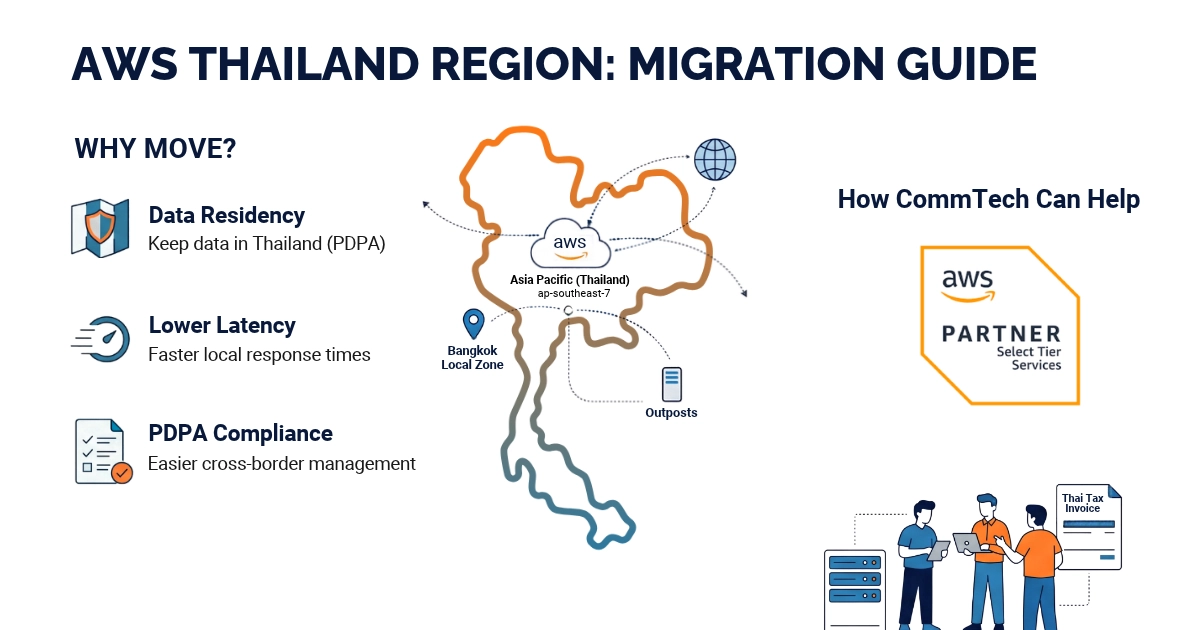
AWS Thailand Region: Should You Move Your Workloads?
AWS launched its Asia Pacific (Thailand) Region (Region code ap-southeast-7) on January 7, 2025, with three Availability Zones, so organizations can now store data and run workloads on AWS inside Thailand. Not every workload should move, though. Decide based on four factors: data residency requirements, where your users are, which AWS services you need, and total cost.
By Chanakarn Techaatik, Solutions Architect (SA), CommTech
What is the AWS Thailand Region?
An AWS Region is a group of AWS data centers in one geographic area. Each Region is divided into multiple Availability Zones (AZs) with separate power and networking. If one AZ has a problem, workloads designed to run across several AZs can keep running.
Before the Thailand Region opened, most Thai organizations used the Singapore Region. AWS already had some infrastructure in Thailand: Amazon CloudFront edge locations (since 2020), AWS Outposts (2020), a Local Zone in Bangkok (2022) and AWS Direct Connect in Bangkok (2023) (AWS News Blog).
Benefits of the Thailand Region
- Data stays in Thailand: Useful for organizations with policies or requirements to keep data in the country, such as some public-sector projects or customer agreements.
- Lower latency for users in Thailand: Suits workloads whose users are mostly in Thailand and need fast response times.
- Simpler cross-border data management: Thailand's Personal Data Protection Act (PDPA) does not require data to stay in Thailand, but transferring personal data abroad comes with conditions. Keeping data in the country makes this easier to manage.
Limitations to know before you decide
- Some services may not be available in a new Region yet: Check the services you need against the AWS Regional Services list before you plan.
- Prices differ between Regions: Compare real costs in the AWS Pricing Calculator using your own workloads.
- Migration has a cost: Data transfer charges, team time and the risk during cutover all need planning so the move is worthwhile.
- Industry requirements: Finance, insurance and healthcare may have additional requirements from their regulators. Check these first.
Which workloads should move, and which can wait
- Consider moving first: Systems that hold large amounts of personal data, such as HR, customer or patient systems. Keeping them in Thailand reduces cross-border data complexity.
- Consider moving: Systems used mostly by people in Thailand that need fast response times, because latency is lower.
- Use as the primary or the secondary site: Backup and disaster recovery (DR). You can keep copies in a different Region.
- No need to rush: Systems that rely on specialized services not yet available in the Thailand Region. Wait until those services are available.
- No need to move: Systems with users around the world. A CDN and multiple Regions work better.
6-point checklist before moving to the Thailand Region
- Identify which systems hold personal data and whether any have data residency requirements.
- Check that every AWS service you use is available in the Thailand Region.
- Compare monthly costs between your current Region and the Thailand Region.
- Estimate data transfer costs and how long the migration will take.
- Plan the cutover to minimize impact on users, with a rollback plan.
- Update your backup and disaster recovery plans to match the new location.
How CommTech can help
CommTech is an AWS Select Tier Services Partner. Our team holds multiple AWS certifications, including AWS Certified Solutions Architect – Professional. We help you assess which systems to move, design the architecture, migrate your workloads and manage costs, and we issue Thai tax invoices for AWS charges. See examples of our AWS work in our projects.
Frequently asked questions
Does AWS have a Region in Thailand?
Yes. It is called Asia Pacific (Thailand), Region code ap-southeast-7, and it opened on January 7, 2025.
Does using the AWS Thailand Region make us PDPA compliant?
No. Where data is stored is only one part. Organizations still need a lawful basis for processing, must respect data subjects' rights, and must have appropriate security measures.
How much downtime does moving from the Singapore Region to Thailand require?
It depends on the size and architecture of your systems. Good planning keeps downtime to a minimum.
Is the Thailand Region cheaper than Singapore?
Prices vary by service. Compare them using your actual workloads.
Do we need to move every system to Thailand?
No. Move only the systems that clearly benefit.
Want to know which of your systems should move to the Thailand Region? Talk to CommTech's AWS team.
Explore Our Blog Posts
Stay updated with our latest blog posts.

IPv4 vs IPv6: What's the Difference and Why It Matters

Computer Rental for Government Agencies: 4 Benefits and How to Procure It

VMware Cloud Foundation: Taking Your Data Center to Hybrid Cloud
Join our newsletter for updates
Stay informed with our latest news and promotions
